
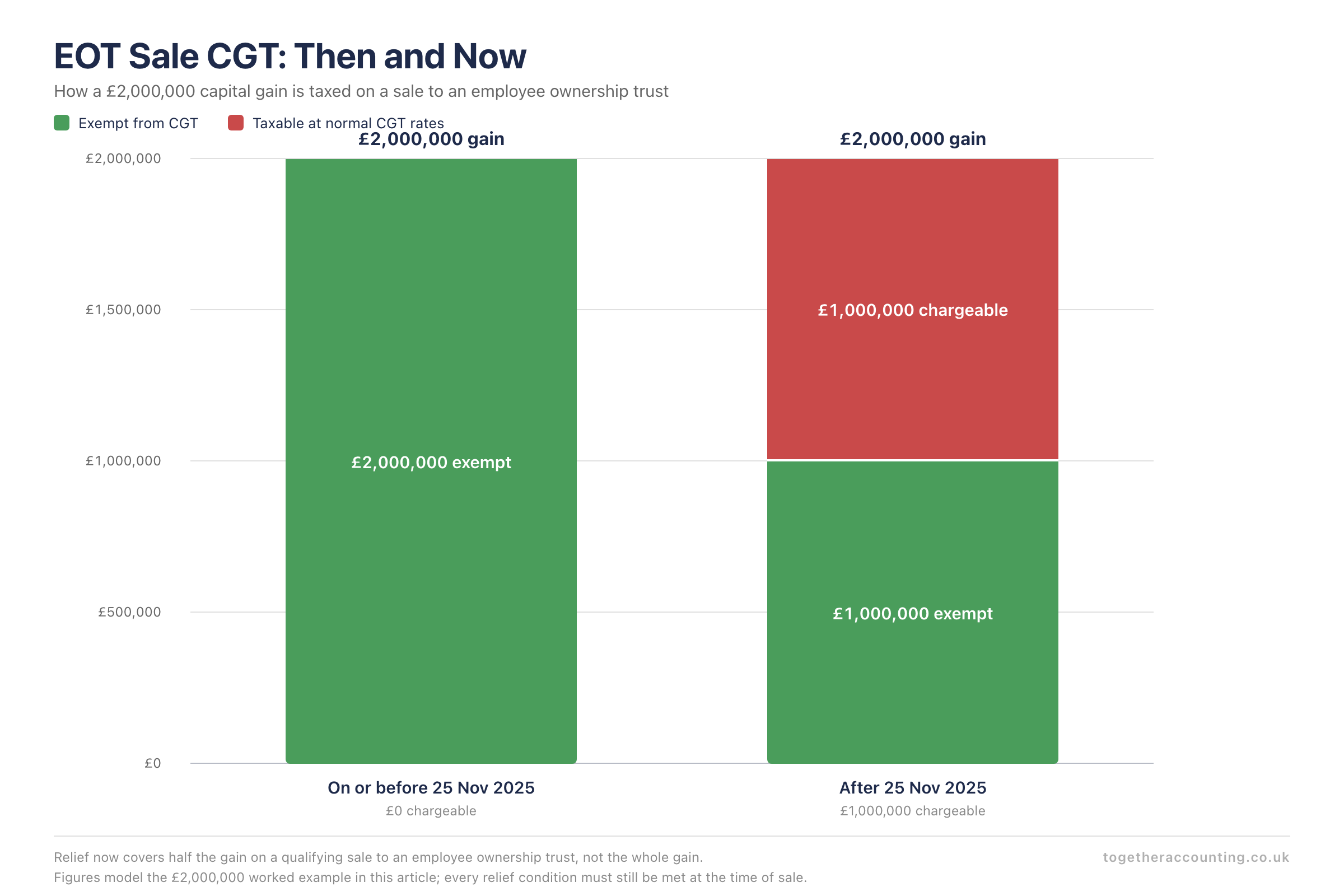
The tax case isn’t what it was, though. A sale to an EOT used to be completely free of capital gains tax. Relief now covers only half the gain, and a tougher set of trustee rules sits on top. Plenty of what you’ll read online hasn’t caught up.
The headline points:
- Capital gains tax relief on a sale to an EOT currently covers 50% of the gain, not 100%
- The trust must end up with a controlling interest, meaning more than 50% of the company
- Trustees must be UK resident, independent of the former owners, and mustn’t pay more than market value
- Employees can get up to £3,600 a year in bonuses free of income tax, though National Insurance still applies
- A disqualifying event in the four tax years after the sale can claw back the seller’s relief
On paper, halving the relief looks like the end of the EOT as a tax play. We don’t see it that way. It just means the decision has to stand up on its commercial merits, which is how it should have been made all along.
“It just means the decision has to stand up on its commercial merits, which is how it should have been made all along.
What is an employee ownership trust?
An EOT is a form of employee ownership where a trust, rather than individual staff, owns a controlling interest in the company. Employees are the beneficiaries of the trust. They don’t hold shares personally, and they don’t have to find any money to buy in. An EOT is a specific type of employee benefit trust built around a transition to employee ownership, not personal shareholding.
The UK rules date from 2014. To qualify, the company must be a trading company or the main company of a trading group. After the sale, the trust has to hold more than half of the share capital and voting rights, a controlling interest in a company its EOT trustees now hold on behalf of the workforce.
John Lewis often gets held up as the model. It’s a fair reference point for employee-owned culture. But its structure predates the 2014 rules and isn’t an EOT in the tax sense.
How does a sale to an EOT work?
Here’s the part that surprises most business owners. The trust usually has no money of its own.
↻ The loop repeats every year, funded from company profits, until the deferred consideration is paid in full.
Together Accounting illustrative diagram of the EOT payment mechanism described in this article.
So the company pays for itself. The trading company makes contributions to the EOT trustee out of its profits, and the trustee passes that cash to the selling shareholders. If there’s spare cash in the business, part of the price can be paid at completion. The rest is almost always deferred consideration: paid in instalments over several years to defer the cash impact, with each one funded by a fresh contribution from the company.
That makes you, the seller, a creditor of your old business. You’re betting on its future profits under new leadership. Some owners are fine with that. Others would rather have the certainty of a trade sale, and it’s better to know which you are early.
Price matters too. The trustees have to take reasonable steps to make sure they don’t pay more than market value. In practice, that means an independent valuation, properly written up.
EOT tax relief: what’s changed
The rules on EOTs have tightened twice in quick succession. First came three new relief requirements on the trustees and the price. Then the capital gains tax exemption was cut in half.
| Area | Old position | Current position |
|---|---|---|
| CGT on the sale to the EOT | 100% of the gain exempt | 50% of the gain exempt, the rest charged at normal CGT rates |
| Trustee residence | No requirement | Trustees must be UK resident as a single body when the sale happens |
| Trustee independence | No requirement | Former owners and connected persons must be fewer than half the trustees, and can’t keep control of the trust |
| Price paid for the shares | No specific test | Trustees must take reasonable steps to keep the price at or below market value |
| HMRC advance clearance on the close-company loan rules (s464A) | Available | No longer given |
| Tax-free employee bonus | Up to £3,600 a year, income tax only | Unchanged |
| Old rules (sale on or before 25 Nov 2025) |
|
||
| Current rules (sale after 25 Nov 2025) |
|
Based on the £2,000,000 worked example in this article: an owner selling 100% of the shares to an EOT. Source: gov.uk HS277 Employee Ownership Trusts and Capital Gains Tax; Together Accounting calculations.
The CGT line is the one that changes the maths. Disposals completed on or before 25 November 2025 kept the full exemption. Anything later gets half.
|
More than 50% |
UK resident |
|
Under 50% |
4 tax years |
The trustee rules matter just as much, because they keep applying after the sale. If one of the relief requirements stops being met in the four tax years after the sale, that’s a disqualifying event. It can claw back the relief you claimed. A trustee board that drifts back under the former owner’s control by year three is exactly the sort of problem that costs real money. Trustee independence has to be real, not just on paper.
“Trustee independence has to be real, not just on paper.
Employee ownership trust accounting treatment
This is the question we get asked most often once a deal is agreed. The answer starts with the company, not the trust.
The trading company’s main entries are the contributions it makes to the EOT trustee. Economically, those look a lot like a dividend. Money leaves the company to fund the purchase of its own shares from the seller.
Where contributions fund the EOT’s purchase price, a specific tax relief stops them being taxed as a normal distribution. It also covers interest on deferred consideration at a reasonable commercial rate, plus the stamp duty on the share purchase. The relief depends on the trustees having taken reasonable steps not to overpay, so the valuation work pays off twice.
On the trustee side, the deferred consideration is the big number. It’s a debt owed to the former shareholders, cleared one instalment at a time, often with interest running on the balance.
Whether the trust gets brought into group accounts depends on how the wider employee ownership structures are set up. It’s a judgement call, not a box-ticking exercise. Agree the treatment with your accountant before the first year-end, not after the deadline has crept up on you.
Honestly, though, the bigger issue is cash. For several years, a healthy slice of profit goes straight out to fund the purchase. Accurate monthly management accounts and a cash forecast you actually look at stop being optional.
“For several years, a healthy slice of profit goes straight out to fund the purchase.
EOT benefits for employees: the £3,600 tax-free bonus
Can you receive a tax-free bonus from an employee ownership trust? Yes, within limits. A company owned by an EOT can pay qualifying bonuses of up to £3,600 per employee each tax year free of income tax.
There are two catches. National Insurance still applies as normal, so the bonus isn’t entirely tax-free. And it has to go to all eligible employees on the same terms. Those terms can vary by pay, length of service or hours worked, but the same formula has to apply to everyone.
Maximum tax-free bonus per employee, per tax year
Eligible employees in this worked example
Total bonus pool paid free of income tax (NI still applies)
Based on the recruitment agency worked example in this article: 25 eligible employees x £3,600 = £90,000. Source: Together Accounting worked example.
A company controlled by an EOT still needs more than a bonus to build real buy-in. Don’t expect the bonus to carry employee engagement on its own. Staff feel like owners when they’re told how the business is doing and asked for their view.
There’s real upside here too. You choose your own timetable, you don’t need to find an outside buyer, and the people who know the business keep running it. For the right company, that’s still worth a lot, even with half the tax relief gone.
What to do if you’re considering an EOT
Deciding whether to sell to an EOT comes down to five practical steps.
Model the capital gains tax on the current basis. Put the EOT figures next to a trade sale or management buyout so you can see actual net proceeds, not the old headline.
Test your trustee board early. Check residence and independence before heads of terms are signed. Fixing it later is harder and riskier.
Commission an independent valuation. The trustees need evidence they didn’t overpay, and you need a price you can defend.
Stress-test the deferred consideration. Run the instalment schedule against a bad year as well as a good one.
Design the bonus scheme before you need it. Agree the basis (pay, service, hours or a mix) and make sure payroll handles the National Insurance correctly.
FAQ
What are the downsides of an EOT?
You’re usually paid in instalments out of future profits, so part of your price depends on how the business does after you leave. Only half the gain is currently exempt from capital gains tax. The trustee independence rules mean you give up control. And a disqualifying event in the four tax years after the sale can claw back the relief. None of that rules an EOT out, but compare it with a trade sale using real numbers.
What happens when an EOT is paid off?
Once the final instalment is paid, the company no longer needs to make contributions to fund the purchase. The trust carries on holding its controlling interest for the long-term benefit of employees. Profits that were going to the seller are free for reinvestment or bonuses.
What happens if an EOT goes bust?
If the company fails before the deferred consideration is fully paid, the seller may never receive the balance, because it depended on profits that no longer exist. That’s the main commercial risk of selling to an EOT. It’s why the instalment schedule should be tested against a bad year, not just a good one.
Can I receive a tax-free bonus from an employee ownership trust?
Yes, up to £3,600 per tax year free of income tax, as long as the bonus goes to all eligible employees on the same terms. National Insurance still applies.
Is selling a business to an EOT still tax free?
Not entirely. Half of the gain on a qualifying disposal to an EOT is currently exempt from capital gains tax, and the other half is taxed at normal rates. All eight relief requirements must be met at the time of sale.
If you’re weighing up an EOT and want someone to run the figures properly, get in touch. It’s exactly the kind of decision we help business owners think through before they commit.
This article gives general guidance based on current legislation. Tax law is complex and fact-specific, so please take advice on your own circumstances before acting on it.
