
The moment your side hustle takes more than £1,000 in a tax year, HMRC wants to hear about it. That’s true even if your main job already runs through PAYE and you’ve never filled in a tax return in your life.
Most people we speak to find out the hard way, usually from a letter. The good news? The rules are simpler than they look, and a side gig run properly from day one costs you very little admin.
The numbers that matter:
Most side hustlers only ever need a couple of those. The trick is knowing which ones apply to you.
The £1,000 trading allowance: what it actually covers
The trading allowance lets you earn up to £1,000 a year from self-employment without paying tax or telling HMRC. Two details catch people out.
First, it’s a gross figure. HMRC measures what comes in, not what’s left after costs, so £1,400 of Etsy sales with £600 of materials is still over the line. Second, you get one allowance, not one per gig. Dog walking, freelance writing, weekend tutoring and the odd bit of eBay selling all get added together.
Once you’re over £1,000, you get a choice. You can deduct your actual business expenses, or you can take the flat £1,000 deduction instead. You can’t do both. If your real costs are low, the flat £1,000 often wins, and it saves you keeping a shoebox of receipts. That’s especially handy for freelancers juggling more than one income stream, where totting up every receipt individually would eat into an evening you don’t have spare.
Where your side hustle income sits
Bar shows gross side hustle income from £0 to £5,000.
Bar shows gross side hustle income from £0 to £5,000. The £1,000 trading allowance itself is not changing; only the reporting route above £3,000 changes once the government’s new threshold takes effect. Source: gov.uk Tax-free allowances on property and trading income; gov.uk side hustler reporting threshold announcement.
Side hustle reporting rules: £1,000 today, £3,000 on the way
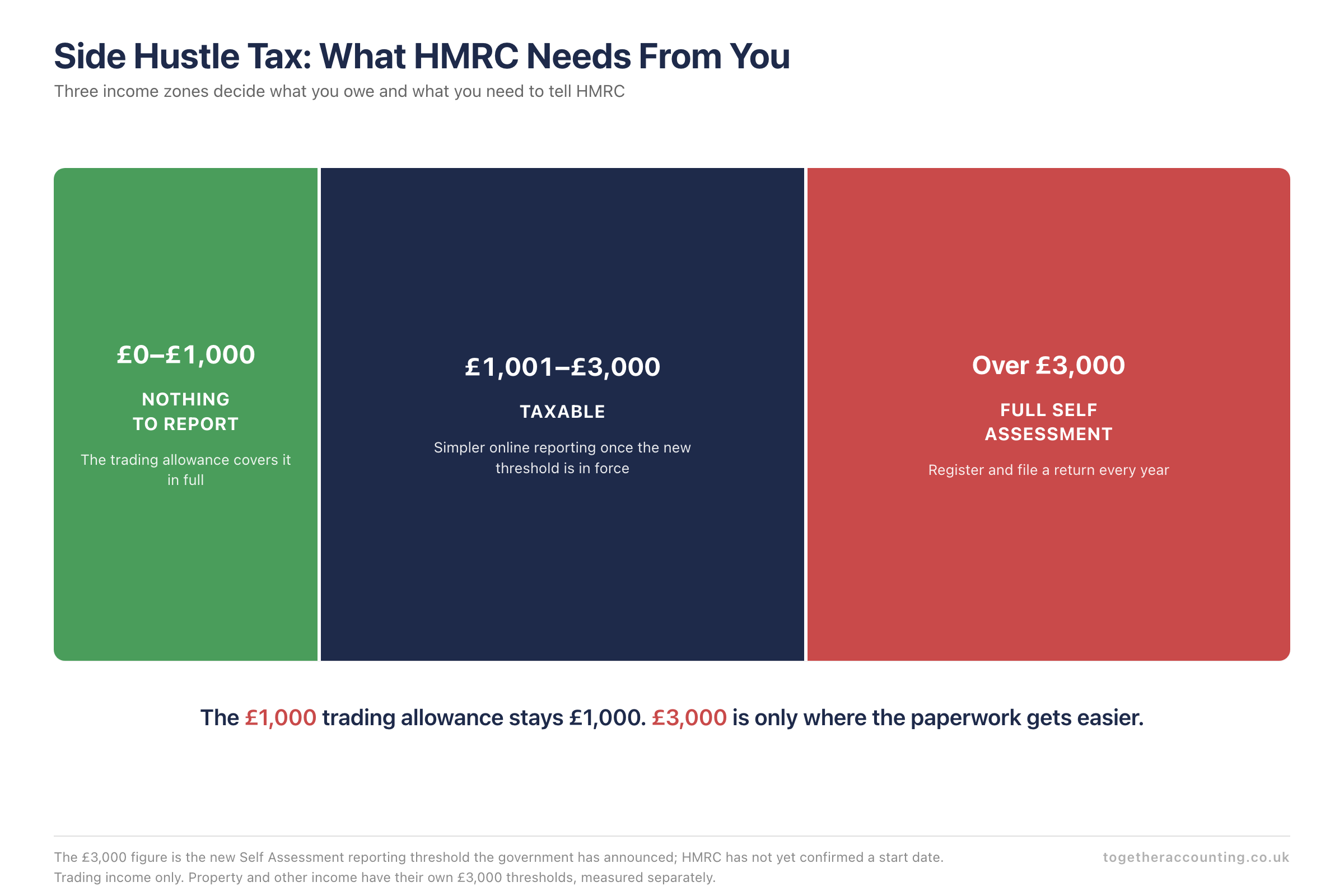
The government has announced that the point at which you need a full Self Assessment tax return for trading income will rise from £1,000 to £3,000. The same £3,000 figure will apply to property income and other income, each measured separately.
Here’s the bit nobody’s properly explaining. The tax-free amount isn’t changing. The trading allowance stays at £1,000. Only the paperwork moves.
| Gross side-hustle income | Tax to pay? | What to tell HMRC now | Once the £3,000 threshold is in force |
|---|---|---|---|
| ✓£1,000 or less | No | Nothing | Nothing |
| ✓£1,001 to £3,000 | Yes, on the amount above your allowance or expenses | Full Self Assessment return | Simpler online reporting service |
| ✓Over £3,000 | Yes | Full Self Assessment return | Full Self Assessment return |
The middle row is where confusion will set in. Plenty of people will read “£3,000 threshold” and assume they can earn £3,000 tax-free. They can’t. HMRC hasn’t confirmed a start date yet (the announcement only says “within this parliament”), so until it does, the £1,000 rule applies in full.
Worked Example: Take someone selling handmade candles on Etsy alongside a full-time job, turning over £2,400 a year. Right now she has to register and file a full return. Using the £1,000 allowance instead of expenses, £1,400 is taxable at her main-job rate. Once the new threshold lands, that £1,400 is still taxable, but she reports it through the simpler route rather than a full return. Her tax bill doesn’t change. Her admin does.
How to manage your side hustle finances in six steps
-
1
1. Register for Self Assessment on time. If you go over £1,000, you need to register as a sole trader with HMRC by 5 October after the end of the tax year you started trading. Your return and any tax are then due by 31 January. Miss those dates and HMRC adds penalties and interest, even when the tax itself is small.Deadline: register by 5 October after the tax year you started trading; your return and any tax are due by 31 January.
-
2
2. Open a separate account for side-hustle money. A dedicated business bank account, or even a second personal account used only for the side gig, is the single cheapest thing you can do for your sanity. Every invoice paid in and every cost paid out sits in one place. When January comes round, your records are already done.
-
3
3. Track income from the first pound. Track income even while you’re under £1,000. If you don’t, you won’t know when you’ve crossed the line, and piecing it together from bank statements the following winter is miserable. Accounting software such as Xero, QuickBooks or FreeAgent will raise an invoice, match payments and, increasingly, read your receipts from a photo. For a small side gig, a simple spreadsheet does the job.
-
4
4. Claim the right expenses. Materials, a share of your phone, software subscriptions and equipment used for the business can all reduce your taxable profit. For travel costs, most small side hustles use HMRC’s approved mileage rates: currently 55p a mile for the first 10,000 business miles and 25p after that.
Worked Example: Picture a weekend driving instructor earning £1,150 from a handful of pupils outside his main job. He drives 800 business miles a year, worth £440 at 55p a mile. Claiming mileage leaves £710 taxable. Taking the flat £1,000 allowance instead leaves just £150. For him the allowance is the better deal by a distance, and he only switches to real costs once his expenses pass £1,000.
Side hustle worked example: mileage or the £1,000 allowance?
Claiming mileage: £710 taxable, after £440 mileage (800 miles at 55p)orFlat £1,000 allowance: £150 taxable, no receipts neededBased on a weekend driving instructor earning £1,150 gross outside his main job. Source: Together Accounting worked example.
Run that comparison every year. The answer changes as the side hustle grows.
-
5
5. Put 20 to 30% aside every month. Your side-hustle profit sits on top of your salary. Your main job has usually used up your £12,570 Personal Allowance already, so every pound of side profit gets taxed at your top rate. Self-employed National Insurance only starts once your side profits on their own pass £12,570, so most small side gigs won’t pay any.
Our general planning range is this. A basic-rate taxpayer should set aside around 20 to 25% of profit, which covers the 20% tax with a little margin. If the extra income nudges you over the higher-rate line, you’ll need nearer 40% on that slice. Move the money monthly by standing order into a separate pot. A lump sum in January is where cash flow problems start.
-
6
6. Watch the VAT and MTD thresholds. Most side hustles never get near VAT, but some do. You must register once your taxable turnover passes £90,000 in any rolling 12-month period, not just at the end of the tax year. So if your side gig is growing fast, check that rolling total every month well before you get close.
Making Tax Digital for Income Tax (HMRC’s move to digital records and quarterly updates) works on similar logic. It already applies if your combined self-employment and property income is over £50,000. It extends to income over £30,000 from April 2027 and over £20,000 from April 2028. Most side hustlers are well under all three for now, but the line is coming down fast.
Making Tax Digital for Income Tax: the threshold is coming down
NowOver £50,000 – Combined self-employment and property income already inside Making Tax Digital for Income TaxApril 2027Over £30,000 – Threshold extends down to combined income over £30,000April 2028Over £20,000 – Threshold extends down to combined income over £20,000. Most side hustles are still well under, but the line keeps coming down.Applies to combined self-employment and property income. Source: gov.uk Find out if and when you need to use Making Tax Digital for Income Tax.
Sole trader or limited company?
Almost every side gig should start as a sole trader. It’s free to set up, the reporting is light and you can keep the trading allowance. A limited company brings extra accounts, filings and costs, and it only starts to make sense once profits are consistently healthy. If you’re approaching that point, talk to us before you incorporate, not after.
Get the basics right and the rest is easy
We see the same thing every January. Side hustlers who tracked everything from the start file in an afternoon, and those who didn’t spend a fortnight in bank statements. The rules aren’t the hard part. The habits are, and staying compliant from day one is what keeps that January afternoon short.
FAQ
Do I need to pay tax on my side hustle?
Only if your gross income from all side gigs goes over £1,000 in a tax year. Below that, the trading allowance covers it and there’s nothing to report. Above it, you pay Income Tax on your profit, after either your actual expenses or the £1,000 allowance.
Will it affect the tax on my main job?
Yes, in the sense that HMRC adds your side profit to your salary when it works out your tax. Because your main job usually uses your Personal Allowance, side profit gets taxed at your top rate, and it can push you into the higher-rate band.
How much tax would I pay on an extra £1,000 a month?
That’s £12,000 a year in extra earnings, well over the allowance, so you’d need a full return. Taking the £1,000 allowance leaves £11,000 of profit. At the basic rate that’s £2,200 of Income Tax. Because £11,000 is under the £12,570 point where self-employed National Insurance starts, there’s no National Insurance to add. If your salary already puts you near the higher-rate threshold, some of it could be taxed at 40%.
Extra £1,000 a month from a side hustle: the numbers
-
✓
£12,000 – Extra gross income a year, at £1,000 a month -
✓
£1,000 – Trading allowance taken instead of actual expenses -
✓
£11,000 – Taxable profit left after the allowance -
✓
£2,200 – Income Tax due at the basic rate; no National Insurance to add
What’s a good side hustle for an accountant?
Bookkeeping for small businesses and tax return preparation are the common choices, and plenty do some tutoring on the side. The same tax rules apply as for anyone else. Check your employment contract and any professional body rules before you take on clients.
What happens if I don’t tell HMRC about my side hustle?
HMRC charges penalties for late registration and late filing, plus interest on unpaid tax. Online platforms such as eBay, Etsy, Vinted and Airbnb now report seller details to HMRC, so undeclared income is far easier to spot than it used to be.
If you’d like someone to check where you stand, or you’re growing faster than you expected, this is exactly the kind of thing we help our clients sort out.
This article gives general guidance based on current legislation. Tax law is complex and depends on your circumstances, so please take advice from a qualified accountant before acting on it.
