
Take a Norwich plumber whose wife spends Tuesday evenings chasing invoices, logging receipts and answering the phone. She’s been doing it for three years, unpaid, and he’s just heard that paying her could cut his tax bill. He’s right, but only if he does it properly.
That’s the situation behind most of the questions we get about the tax implications of family employment. You want to employ a family member who already helps, you’ve heard it’s tax-efficient, and you’ve also heard HM Revenue and Customs (HMRC) takes a dim view of it. Both things are true.
The numbers that matter right now:
Put together, a modest, well-documented family salary can cost the business very little while taking real profit out of the tax net. Get the paperwork wrong, though, and HMRC can strip the whole deduction out.
Why HMRC looks hard at family employment
HMRC’s most recent tax gap figures show the gap widening, and it’s hiring thousands of extra compliance officers to close it. Employing family members is an easy place for an inspector to look, because the tell-tale signs are so familiar. A spouse on £12,570 who never seems to do anything. A teenager on the books at £25 an hour. Wages that appear in the accounts but never leave the business bank account.
None of that means the taxman is against you paying relatives. Its own Business Income Manual (at BIM37735) says a wage is deductible if it’s paid “wholly and exclusively for the purposes of the trade”. In practice, inspectors look for genuine work and weigh three things:
- Was the money actually paid, rather than just credited in the accounts?
- Is there evidence beyond the accounts themselves, such as timesheets, a contract and bank transfers?
- Is the rate in line with the work? A commercial rate for real duties is likely to stand. An above-market rate for a few minor tasks at home is likely to be challenged.
One timing rule catches people out: wages have to be paid within nine months of the end of the accounting period to be deducted in that period. Accruing a big year-end “salary” for your spouse and paying it the following autumn doesn’t work.
Tax benefits of employing family members properly
So what’s the actual saving? A genuine salary is a business expense, which reduces your taxable profit. If that salary falls inside the family member’s own Personal Allowance, nobody has to pay income tax on it at all. For a sole trader paying 40% on top-slice profits, moving that money to a spouse with no other income is a clean saving.
The National Insurance contributions side needs more care, and it’s the part people usually get wrong.
- Employer NI currently starts at the Secondary Threshold, £96 a week (£5,000 a year), at 15%.
- Employee NI currently starts at the Primary Threshold, £242 a week (£12,570 a year).
- The Lower Earnings Limit is currently £129 a week (£6,708 a year). Pay at or above this and the family member builds up their National Insurance record towards the State Pension, even though they pay no NI themselves.
Here’s the thing: the Lower Earnings Limit now sits above the employer threshold. So you can’t get a qualifying State Pension year for someone without crossing into employer NI territory. That’s where the Employment Allowance comes in. If you’re eligible, it wipes out up to £10,500 of employer NI a year, which comfortably covers a small family salary. A limited company whose only employee is a director can’t claim it, so check the true cost of employing someone before you rely on it.
Worked Example: Take that sole trader plumber. His wife works 10 hours a week on invoicing and bookkeeping, and he pays her £130 a week (£13 an hour, above the minimum wage), or £6,760 a year.
- Above the Lower Earnings Limit, so she builds a qualifying State Pension year
- Below the Primary Threshold, so she pays no employee NI
- Inside her Personal Allowance, so no income tax if she has no other income
- Employer NI on the £34 a week above £96: roughly £265 a year, covered in full by the Employment Allowance
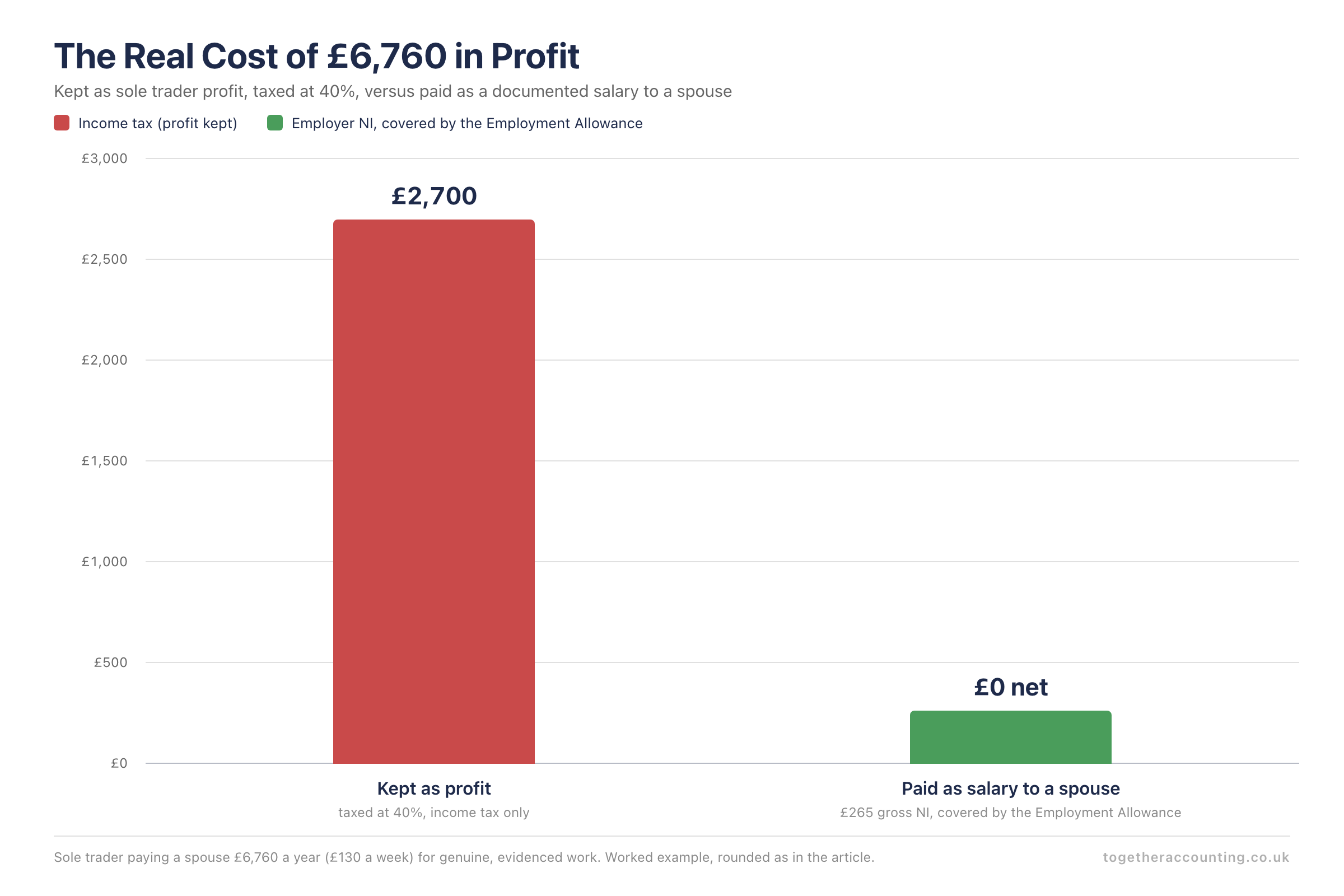
- Result: £6,760 comes off his taxable profit, and at a 40% marginal rate that’s around £2,700 less income tax, before his own NI saving
The deal only holds because there’s a contract, a weekly timesheet and a bank transfer every Friday.
The National Insurance thresholds that decide what a family wage costs
£5,000 a year (£96 a week)
Secondary Threshold – employer NI at 15% starts above this
£12,570 a year (£242 a week)
Primary Threshold – employee NI starts above this
£6,708 a year (£129 a week)
Lower Earnings Limit – pay above this and the year counts towards State Pension
Up to £10,500 a year
Employment Allowance – can wipe out employer NI on a small family salary
Tax and NI cost of £6,760 in profit: kept vs paid as a documented salary to a spouse
taxed at 40%
to a spouse
Based on the £6,760 salary worked example. Kept as sole trader profit and taxed at a 40% marginal rate, the income tax cost is around £2,700. Paid instead as a documented salary to a spouse with no other income, the business owes roughly £265 in employer NI, fully covered by the Employment Allowance for eligible employers. Source: Together Accounting worked example.
Minimum wage rules for family workers
If a family member is a genuine worker, the minimum wage applies to them just as it would to anyone else. Current hourly rates are:
| Category | Current hourly rate |
|---|---|
| National Living Wage, aged 21 and over | £12.71 |
| Aged 18 to 20 | £10.85 |
| Under 18 and apprentices | £8.00 |
Children below school-leaving age aren’t entitled to the minimum wage, but that doesn’t mean you can pay them anything. HMRC still asks whether the rate matches the work, and the strict child employment rules on hours and type of work still apply.
There’s a narrow exemption for family members who live in your home and help run a family business. We don’t recommend leaning on it. A wage below the minimum makes the arrangement look informal, and informal arrangements are exactly what cause problems with HMRC. Treat the minimum wage as your floor and set pay at the market rate for the type of work being done.
Spouse dividends: the part most guides miss
Salary is only half the picture if you run a limited company. Where your spouse or civil partner owns shares, the company can pay them dividends too, and dividends carry no National Insurance at all.
With dividend tax currently at 10.75% for basic-rate taxpayers and 35.75% at the higher rate, getting income into the hands of a lower-earning spouse matters more than it used to. A spouse with no other income can take their Personal Allowance through a small salary, then use the £500 dividend allowance and the basic-rate band on dividends.
Dividend tax rates for a spouse shareholder
Dividends carry no National Insurance. The dividend allowance is £500. Source: gov.uk Tax on dividends.
Personal Allowance a family member can earn tax-free
Employment Allowance that can wipe out employer NI on a family salary
Dividend allowance a spouse shareholder can take tax-free
If you employ your spouse and also hand them shares, the catch is the settlements legislation (section 624 onwards of the Income Tax (Trading and Other Income) Act 2005). It exists to stop you creating artificial arrangements that divert income to a family member while keeping the real benefit yourself. The House of Lords decided the leading case, Jones v Garnett (often called Arctic Systems), in 2007. The couple won because the wife’s shares were ordinary shares, given outright, with full voting, capital and dividend rights. Gifts between spouses of that kind fall outside the rules, even when the split is clearly tax-driven.
So the share transfer has to be real. That means a stock transfer form, an updated register of members and a confirmation statement at Companies House, all done before any dividend is declared. A revocable side deal or “income-only” shares won’t do, so it’s worth checking how directors split pay between salary and dividends before you set it up.
Adult children can hold shares on the same outright basis, but gifts to children under 18 are treated differently under the settlements rules. Take advice before putting shares in a child’s name.
Setting up family employment that stands up to HMRC
If you employ family members, whether a spouse or partner, a child or another relative, the same evidence rules apply. Think of it like an MOT: the checks are dull, but they’re what keeps you on the road. We’d build the evidence file from day one to meet HMRC requirements, not scramble for it after a letter arrives.
- Write a contract and job description. Name the actual duties and hours.
- Benchmark the rate. Note what an outside bookkeeper or admin assistant would charge locally, and keep that note on file.
- Run it through payroll. Register for PAYE, report through RTI (reporting pay to HMRC each payday) and issue payslips. Paying a relative cash with no payroll record is the fastest way to lose the deduction.
- Pay into their own bank account, on a regular schedule, never into a joint pot you control.
- Keep work records. Timesheets, emails and anything they produce will prove the work was done.
- Consider pension contributions. Employer contributions for a family employee are a business expense and carry no employer or employee NI. For a company, that means less corporation tax. The standard annual allowance is currently £60,000, though the total package still has to be justifiable for the work done.
Family members can legitimately work for sole traders too, and most of this evidence-building applies the same way. The one thing a sole trader can’t do is pay dividends, so if salary alone isn’t moving the dial, that’s a sign to review your structure.
Frequently asked questions
What are the tax benefits of employing family members?
A genuine wage reduces your taxable profit and uses the family member’s own Personal Allowance, so income taxed at 40% in your hands can be taxed at nothing in theirs. Pitch it at or above the Lower Earnings Limit and they also build State Pension years.
Can I pay a family member a salary?
Yes, provided they do real work, you pay a rate that reflects the work and the money actually reaches them. Miss any of those and HMRC may disallow the expense. That’s not because the employee is a relative.
Can I employ my 12 year old son?
In most cases, no. The general minimum age for part-time work is 14, and only some local councils allow it from 13. There are exceptions for areas like television, theatre and modelling, which need a performance licence. Your local council sets the rules on hours and types of work and may require a work permit, so check with them first.
Can I pay my spouse a salary and dividends?
Yes, if your spouse is a genuine shareholder in your limited company. A modest salary uses their Personal Allowance, and dividends on shares they own outright are taxed at their rates, not yours. The shares must carry full rights and be properly transferred before any dividend is declared.
What happens if HMRC disallows part of the salary?
If HMRC successfully challenges part of the salary paid, the disallowed amount gets added back to your profits, so you pay tax on it as if you’d never claimed the tax deduction. Interest runs from the original due date, and penalties can follow if HMRC decides you were careless.
What is the word for employing family members?
The word is nepotism. In tax terms it’s simply family employment, and it’s perfectly legitimate when the job is real.
If you already have a relative helping out, or you’re thinking about moving shares to your spouse, we’ll look at whether the numbers work for your business and what paperwork you need before HMRC ever asks.
This article provides general guidance based on current legislation. Tax and employment law are complex and fact-specific. The information here should not be relied upon as advice for your particular circumstances. Please consult a qualified accountant or professional advisor for guidance tailored to your situation.
