
If you’re a UK limited company director, you’ve probably asked yourself the same question every spring: salary or dividends, and how much of each? The answer hasn’t moved much, but it costs you more than it used to.
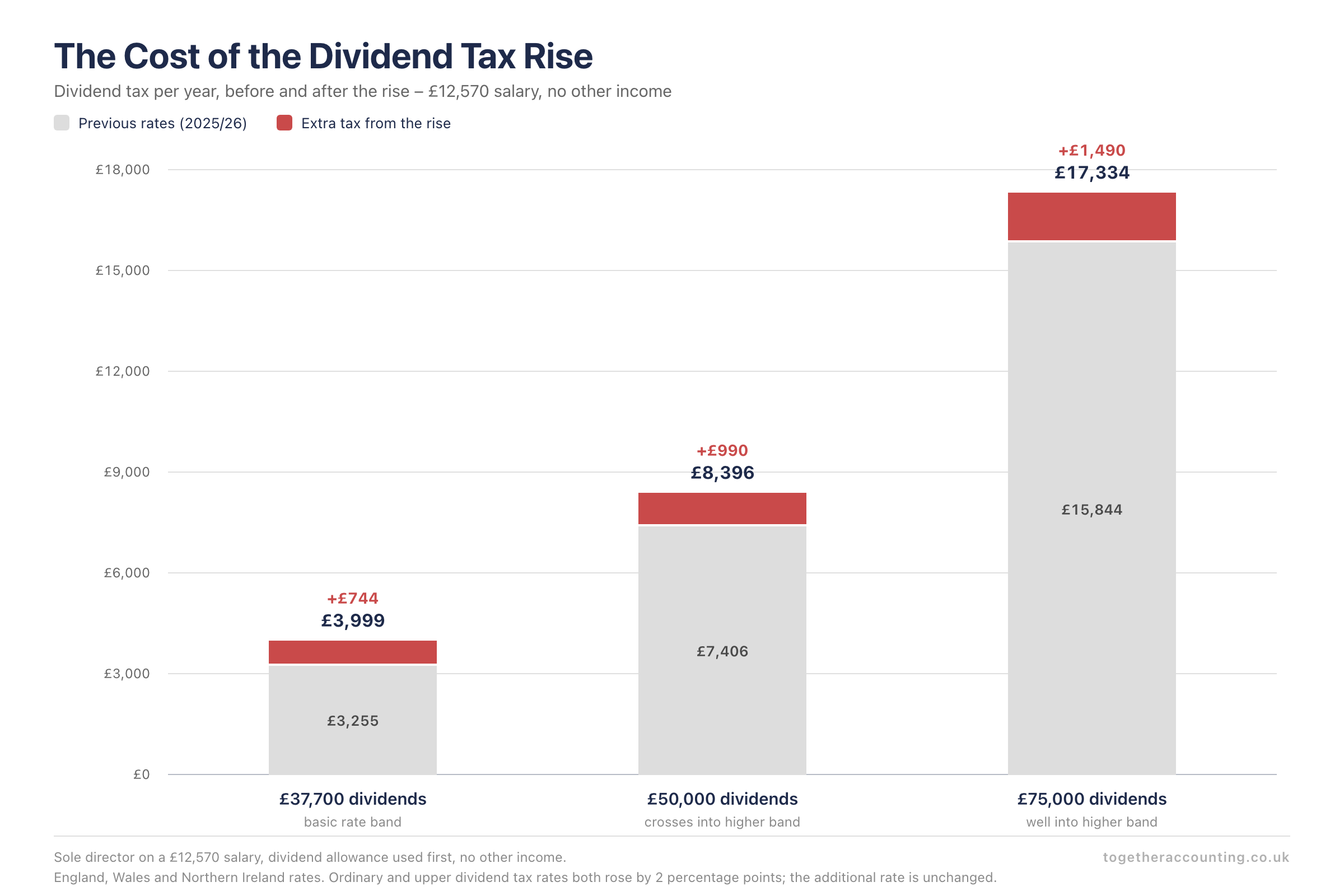
Here’s the short version. Take a salary of £12,570 and draw the rest of your pay as dividends. That’s still the most tax-efficient way to pay yourself for most single directors. What’s changed is the price of every dividend pound above that salary, because dividend tax rates went up by two percentage points.
Salary vs dividends: the worked example
Numbers first. Take a sole director paying themselves a £12,570 salary, which uses up their personal allowance, and drawing dividends on top with no other income. This is director pay in its simplest form: a fixed salary plus a dividend top-up.
| Dividends drawn (on a £12,570 salary) | Dividend tax (2025/26 rates) | Dividend tax (at current rates) | Extra tax per year | Take-home (at current rates) |
|---|---|---|---|---|
| £37,700 (all in the basic rate band) | £3,255 | £3,999 | +£744 | £46,271 |
| £50,000 (crosses into the higher band) | £7,406 | £8,396 | +£990 | £54,174 |
| £75,000 (well into the higher band) | £15,844 | £17,334 | +£1,490 | £70,236 |
Assumes the £500 dividend allowance is used first and no other income. England, Wales and Northern Ireland rates.
Look at the gap between the first two rows. Once your total income passes £50,270, every extra dividend pound is taxed at 35.75% rather than 10.75%, and that’s where most of the pain sits. Stay inside the basic rate band and you hand over roughly a tenth of your dividends. Drift past it and more than a third of the slice above goes to HMRC.
None of these figures will sink a business. They’re still real money, though, and the director in that table hasn’t earned a penny more to deserve the bigger tax liability.
Dividend tax rates and the dividend allowance
The current dividend tax rates are:
- Ordinary (basic) rate: 10.75%, up from 8.75%
- Upper (higher) rate: 35.75%, up from 33.75%
- Additional rate: 39.35%, unchanged
- Dividend allowance: £500
Dividends above the £500 allowance sit in one of these bands, so the rate that applies depends on your total income for the year.
Extra dividend tax per year from the dividend tax rise (£12,570 salary)
(basic rate band)
(crosses into higher band)
(well into higher band)
Sole director on a £12,570 salary, dividend allowance used first, no other income. England, Wales and Northern Ireland rates. Source: Together Accounting worked example.
Dividend tax rate changes
2025/26
8.75%
Current
10.75%
2025/26
33.75%
Current
35.75%
2025/26
39.35%
Current
39.35%
The dividend allowance stays at £500. Additional rate unchanged; the ordinary and upper rates both rose by 2 percentage points. Source: gov.uk Tax on dividends.
The rise is in the Finance Act 2026, so it’s settled law rather than a Budget proposal. And it lands on top of something quieter. The personal allowance and the higher-rate threshold are currently frozen, so as your company profits grow, more of your dividend income slides into the 35.75% band without anyone announcing a thing.
Let me be blunt about the direction of travel. The dividend allowance was £5,000 when it arrived in 2016. It’s £500 now. Every change since has chipped at the same structure, and I don’t expect that to stop.
What is the optimal director salary?
For most directors, £12,570. It sits exactly on the personal allowance and the employee National Insurance threshold, so you pay no income tax and no employee NI on it.
Your company does pay employer National Insurance at 15% on everything above £5,000. On a £12,570 salary that comes to £1,135.50 a year. Sounds like a cost worth dodging? For most companies it isn’t, because the salary and the employer NI are both deductible expenses, so the company gets corporation tax relief on the lot.
Here’s what that looks like for a sole director whose company pays the 19% small profits rate (profits of £50,000 or less). Compared with a salary of £6,708, the lower earnings limit, paying £12,570 means the extra corporation tax relief beats the extra employer NI by about £401 a year. Small, but it’s money the lower salary simply leaves on the table.
If you have at least one other employee, it gets better. The Employment Allowance, currently £10,500, can wipe out the employer NI on your salary entirely. Run the same comparison and the company comes out about £1,114 a year ahead. That gain comes purely from corporation tax relief on the extra salary, because with no NI to pay there’s no NI to deduct. A sole director with no other staff can’t claim the allowance. But if you do have someone else on the payroll and you’re not claiming it, fix that before your next pay run.
There are exceptions, and they matter:
- A loss-making or break-even year. With no corporation tax to save, the employer NI becomes a straight cost, and a lower salary can make more sense until the corporation tax position improves.
- Other income. If a job, a pension or rental profits already use your personal allowance, a £12,570 PAYE salary gets taxed.
- Income near £100,000. Your personal allowance shrinks by £1 for every £2 above that line, and the salary versus dividend balance shifts with it.
These are the cases where a calculator gives you a confident number that’s quietly wrong, because it can’t see your personal tax position.
Is it better to take dividends or salary?
For most directors, a combination of salary and dividends still wins. Pay above £12,570 as salary and it attracts income tax, employee National Insurance and 15% employer National Insurance. Dividends carry no National Insurance on either side, which is the whole reason the structure exists. It’s the combined weight of income tax and National Insurance that pushes the balance towards dividends once your salary clears £12,570.
The rise hasn’t changed that ranking. It’s narrowed the gap, and it’s made the extras around the tax-efficient salary and dividend split worth a lot more than they were. That’s where a proper review earns its keep, and it’s the part a dividend calculator can’t do for you.
Three ways to reduce your dividend tax bill
Employer pension contributions
This is the one most directors underuse. Take £10,000 out as a dividend as a higher-rate taxpayer and £3,575 goes in dividend tax alone, before you even count the corporation tax the company paid on that profit first.
This is the cleanest way to reduce corporation tax while keeping the money working for you. Put the same £10,000 into your pension as an employer contribution and the whole amount lands in the pot. There’s no dividend tax, because the money never passes through your hands. The company deducts it from taxable profit too, which saves £1,900 at the 19% corporation tax rate. If profits sit between £50,000 and £250,000, marginal relief means each extra pound is effectively taxed at 26.5%, so the corporation tax saving rises to £2,650. You’ll pay income tax when you draw the pension in retirement, but most directors retire on a lower marginal rate than they pay today.
The pension annual allowance is currently £60,000, covering employer and personal contributions together. It tapers down for very high earners, and unused allowance from the previous three tax years can often be carried forward.
Worked Example: Picture a Norfolk joinery business with one director and company profits of around £90,000. The director is already a higher-rate taxpayer and wants another £20,000 out of the company. Drawn as a dividend, that £20,000 costs £7,150 in dividend tax. Paid into the director’s pension instead, it costs nothing in dividend tax, and because profits fall from £90,000 to £70,000 (still inside the marginal relief band) the company’s corporation tax bill drops by £5,300. The wrinkle: the director has only paid in £10,000 a year recently, so there’s unused allowance from earlier years that could support a bigger contribution, as long as they were a member of a pension scheme in those years.
Why £12,570 beats a lower salary
£1,135.50
Employer National Insurance on a £12,570 salary, at 15% above the £5,000 threshold
£401 a year
Extra corporation tax relief over the £6,708 lower earnings limit, sole director, 19% small profits rate
£1,114 a year
Same comparison with the Employment Allowance in place – no employer NI to pay, so it’s all corporation tax relief
£10,500
Employment Allowance, currently available to companies with at least one other employee on the payroll
Taken as a dividend
£3,575
Dividend tax on £10,000 at the higher rate, before corporation tax on the profit
Paid into a pension
£0
Dividend tax on the same £10,000 as an employer pension contribution – the full amount lands in the pot, plus £1,900 to £2,650 saved in corporation tax
Spouse and family shareholdings
Worked Example: Picture a Norwich engineering consultancy owned by one director who’s already a higher-rate taxpayer. Their spouse holds genuine shares in the company and has no other income. The spouse can receive £13,070 in dividends completely tax-free, using their £12,570 personal allowance plus their tax-free dividend allowance of £500. Paid to the director instead, that same £13,070 would sit in the 35.75% band and cost around £4,673 in dividend tax. Even for a basic-rate director, moving it saves about £1,405 a year.
The catch is the shares. They need to carry real economic rights, not dividend rights on their own, or HMRC’s settlements rules can pull the income straight back to you. Set it up properly and it’s well-established, legitimate tax planning. Set it up on the back of an envelope and it isn’t.
Use your basic rate band every year
Your basic rate band resets on 6 April and anything unused on 5 April is gone for good. If you’ve got distributable reserves and headroom below £50,270, a dividend before the year closes is taxed at 10.75% instead of 35.75% the following year. Remember you can only pay dividends from distributable reserves, never from profits you hope to make.
One more thing to watch. If you borrow from the company through your director loan account and the balance isn’t cleared within nine months of the year-end, the company pays a section 455 charge. That rate is tied to the dividend upper rate, so it’s currently 35.75%. You get it back when the loan’s repaid, but it ties up cash in the meantime.
Your salary and dividend checklist
- Confirm your salary at the start of the tax year rather than rolling last year’s figure forward.
- Plan your dividends against the £50,270 line, and the £100,000 line if you’re close to it.
- Model a pension contribution before your company’s year-end, which isn’t necessarily 5 April.
- Check your spouse’s shareholding and whether their allowances are being used.
FAQs
What is the optimal salary for directors?
For most single directors it’s currently £12,570. That’s the personal allowance, so there’s no personal income tax or employee National Insurance to pay, and the company gets corporation tax relief on the salary and the employer NI. Loss-making companies and directors with other income may do better with less.
What is the dividend allowance?
Currently, the dividend allowance is £500. The first £500 of dividend income is tax-free, and dividends are taxed at 10.75%, 35.75% or 39.35% above that, depending on which income tax band it falls into.
Is it better to take dividends or salary?
For most limited company directors, a small salary plus dividends is still more tax-efficient than salary alone, because dividends carry no National Insurance. The dividend tax rise has narrowed the gap, so pensions and family shareholdings now do more of the heavy lifting.
How much dividends can I pay myself as a director?
As much as the company’s distributable reserves allow, meaning its accumulated profits after corporation tax. There’s no fixed legal cap beyond that, but the tax cost jumps once your total income passes £50,270 and again above £100,000, so the right figure is usually set by your tax bands rather than the bank balance.
This article applies to England, Wales and Northern Ireland. Scottish taxpayers pay different income tax rates on salary and should take separate advice.
We see the same thing every year: directors who set their split in April and forget it pay more than the ones who check it twice. If you’re still weighing up director salary or dividends, get in touch and we’ll run your own numbers. It’s exactly the kind of thing we help our Norwich and Norfolk clients with every week.
This article provides general guidance based on current legislation and practice. Tax and employment law are complex and fact-specific. The information here should not be relied upon as advice for your particular circumstances. Please consult a qualified accountant or professional adviser for guidance tailored to your situation.
