
When I first wrote this piece in the summer of 2025, the employer National Insurance rise had just landed and day-one unfair dismissal rights looked certain. Some of that has moved. The direction of travel hasn’t. Costs keep climbing, the paperwork keeps growing, and the smallest firms still have the least room to absorb either, however much ministers talk about economic growth.
What’s changed in government policy since we first published this
Here’s where things stand now:
- National Insurance: the 15% employer National Insurance contributions rate and the £5,000 threshold are still in place. The Employment Allowance is currently £10,500, and I should have mentioned it first time round.
- Wages: the National Living Wage has gone up again, to £12.71 an hour.
- Employment law: the Employment Rights Act 2025 is now law, but day-one unfair dismissal rights didn’t survive. The qualifying period drops to six months instead.
- Making Tax Digital: it now covers sole traders and landlords with qualifying income over £50,000.
- Business rates: England and Wales have both scrapped the single multiplier and now use several tiers.
Some of that is better news than I expected. Most of it still adds cost or admin, and it all lands on the same owners.
Employer National Insurance is still the heaviest blow
The April 2025 change raised the employer rate and dragged the threshold down, so you pay more on a bigger slice of every salary. Both parts are still in force. The threshold is frozen, too, so every pay rise quietly adds to the bill.
| Cost area | Before April 2025 | Currently |
|---|---|---|
| Employer NI rate | 13.8% | 15% |
| Threshold per employee, per year | £9,100 | £5,000 |
| Employment Allowance, per eligible employer | £5,000 | £10,500 |
That bigger allowance is the one piece of genuine relief in the package. Whether it helps you depends almost entirely on how many people you employ.
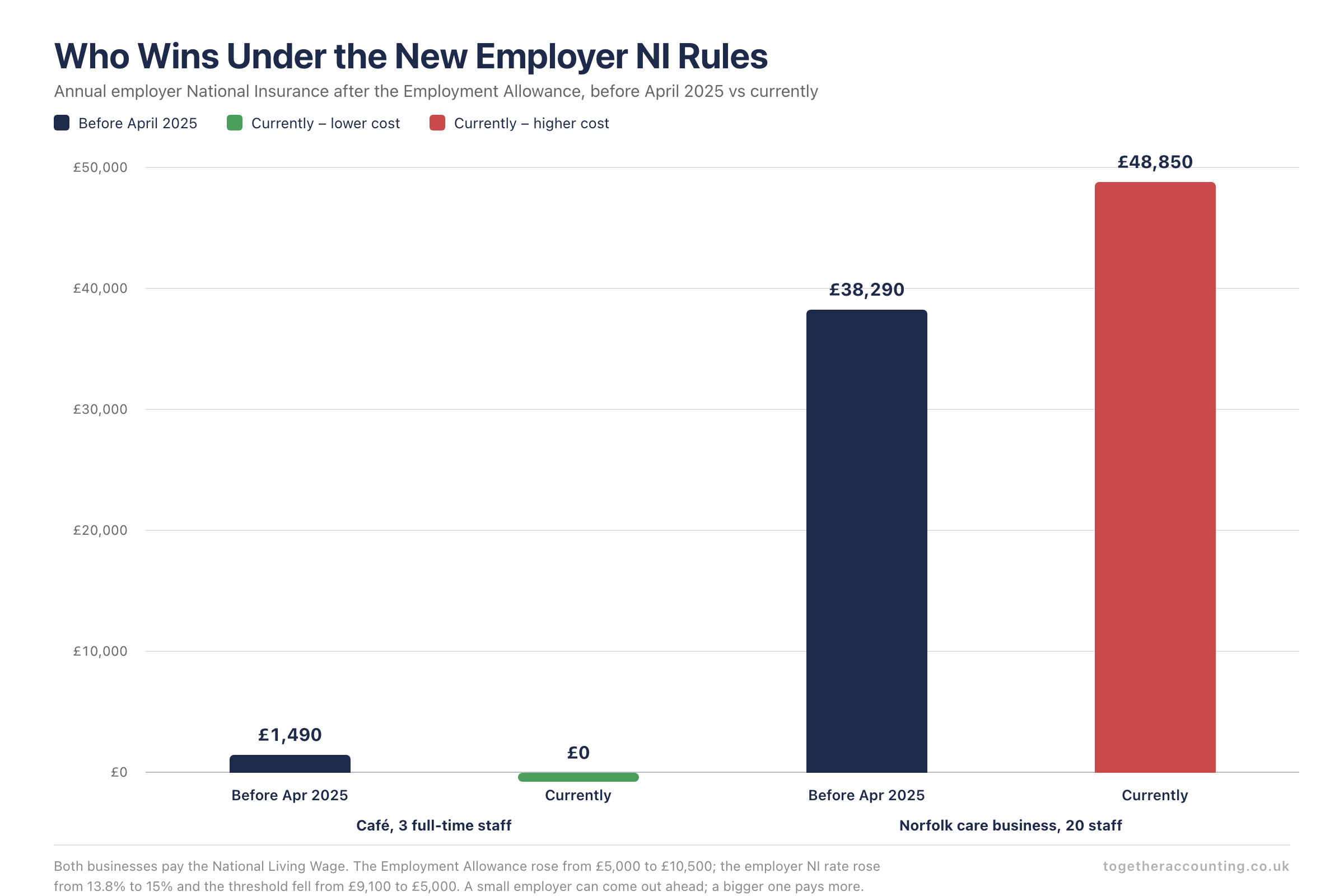
Employer NI after the Employment Allowance: who wins, who loses
| Café, 3 full-time staff on the National Living Wage |
Before April 2025 £1,490 |
→ |
Currently £0 |
| Norfolk care business, 20 staff on the National Living Wage |
Before April 2025 £38,290 |
→ |
Currently £48,850 |
Annual employer NI after the Employment Allowance, both businesses on the National Living Wage. The £10,500 Employment Allowance wipes out the café’s bill; the care business still pays £48,850, about £10,560 more than under the old rules. Source: Together Accounting worked examples.
Worked Example: Take a café with three full-time staff, each on the National Living Wage for 37.5 hours a week. That’s about £24,785 a year per person. Employer NI currently comes to roughly £2,968 each, or £8,903 in total, and the £10,500 Employment Allowance wipes it out completely. Under the old NI rules, on the same wages, the café would have paid about £1,490 after its £5,000 allowance. For this business, the change is a small win.
Now picture a Norfolk care business with 20 staff on the same pay. Employer NI across the team comes to about £59,350, falling to roughly £48,850 once the allowance is claimed. Under the old rules it would have been about £38,290. That’s an extra £10,560 or so a year from the NI changes alone, before any pay rise or pension contribution.
“That’s the part the headlines missed. Micro-employers who claim the allowance can come out ahead. Beyond a handful of staff, it barely dents the increase.
Robert Marjoram, Director
The National Living Wage: fair for workers, hard on margins
The National Living Wage is currently £12.71 an hour for workers aged 21 and over. The rate for 18 to 20 year olds is £10.85, and under-18s and apprentices get £8.00.
National Living Wage and National Minimum Wage, by age band
| Aged 21 and over (National Living Wage) |
|
||
| Aged 18 to 20 |
|
||
| Under 18 and apprentices |
|
Hourly rates, current. Source: gov.uk National Minimum Wage and National Living Wage rates.
I don’t begrudge anyone a pay rise, and £12.71 an hour isn’t a fortune. My complaint is the way it stacks on top of everything else.
A full-time worker on the National Living Wage now costs an employer roughly £27,750 a year in pay and employer NI. That’s before auto-enrolment pension. For a hospitality or care business running on thin margins, every rise lands in full and has to come from somewhere: prices, hours, or the owner’s own pay.
Employment law: the day-one U-turn
First time round, I called day-one unfair dismissal rights in the then Employment Rights Bill a hiring deterrent. The government seems to have reached the same conclusion.
The Employment Rights Act 2025 is now law. Instead of a day-one right, the qualifying period for unfair dismissal claims falls from two years to six months, from 1 January 2027. That’s a real climbdown, and I’m glad of it.
But don’t relax just yet. As part of the compromise, the cap on unfair dismissal compensation goes too. For a six-person business with no HR department, an uncapped claim is a far scarier prospect than it is for a large employer with an in-house legal team. And six months is a short window to decide whether a new hire is working out.
Other changes are already live. Paternity leave and unpaid parental leave are now day-one rights, and most of the Trade Union Act 2016 has been repealed. If your contracts and staff handbook haven’t been updated, they’re already out of date.
Making Tax Digital reaches sole traders and landlords
Making Tax Digital for Income Tax now applies to sole traders and landlords with qualifying gross income over £50,000. The threshold drops to £30,000 from April 2027 and £20,000 from April 2028.
If you’re caught, you need compatible software, digital records and quarterly updates to HMRC on top of your annual return. The government sells this as simplification. For a landlord with two rental flats who used to file once a year, it means more deadlines and a new software bill, another layer of tax compliance on an already complex tax system.
Watch those lower thresholds. Plenty of part-time landlords and side-hustlers who think this doesn’t apply to them will be in scope within two years.
Business rates: new multipliers, same postcode lottery
England no longer has one small business multiplier. It currently has five:
- Small business: 43.2p
- Standard: 48.0p
- Small retail, hospitality and leisure: 38.2p
- Standard retail, hospitality and leisure: 43.0p
- High-value premises (rateable value of £500,000 or more): 50.8p
England’s five business rates multipliers, pence per £ of rateable value
| Small retail, hospitality and leisure |
|
||
| Small business |
|
||
| Standard retail, hospitality and leisure |
|
||
| Standard |
|
||
| High-value premises (rateable value £500,000+) |
|
England only; Wales runs three multipliers and Scotland its own system. Source: gov.uk notification of non-domestic rating multipliers.
Wales has moved to three multipliers, and Scotland runs its own system.
The lower retail, hospitality and leisure rates should help the high street, and I’ll give the government credit for that. The catch is complexity. Your bill now depends on your sector, your rateable value and which side of a border you trade on, so two near-identical shops can pay very different amounts.
Government support for small business looks better on paper
Every government can point to a list of business support schemes. Innovate UK offers grants for research and development, the British Business Bank offers Start Up Loans to new business owners, Growth Hubs offer business growth support, and there’s the Help to Grow: Management programme, aimed at boosting SME productivity. Very little of it reaches the smaller firms I see day to day. Innovate UK funding is competitive and slow to apply for. Start Up Loans are personal loans, so you carry the debt yourself. None of it touches what owners actually raise with us: the cash flow squeeze from late payment from bigger customers and the compliance costs of getting it right.
Late payment is where that’s starting to change, and fair play to the government for tackling late payments. Its Small Business Plan, Backing your business, published in July 2025, promised the biggest late payment reform in over 25 years. The Commercial Payments Bill going through Parliament plans to cap payment terms at 60 days, make 8% interest above base rate compulsory on late invoices, and let the Small Business Commissioner investigate and fine persistent late payers. None of that is law yet. Currently, large firms just report their payment record twice a year, and the government says the 60-day cap won’t start before 2027. Until then, chasing invoices is still your job.
“Here’s the thing about regulatory burden. A new rule costs a big company and a small one the same few days of admin, but the big company spreads it across hundreds of staff. A five-person firm absorbs it in the owner’s evenings.
Robert Marjoram, Director
Is anything getting better?
England and Wales company insolvency rate, per 10,000 companies
| 2008 to 2009 crash peak |
|
||
| Year earlier |
|
||
| Year to August 2026 (currently) |
|
Company insolvencies per 10,000 companies, England and Wales. Currently down from a year earlier and far below the 2008 to 2009 crash peak. Source: GOV.UK company insolvency statistics, August 2026.
A little. The company insolvency rate in England and Wales was 50.1 per 10,000 companies in the year to August 2026, down from 52.5 a year earlier. It’s also far below the peak of 113.1 during the 2008 to 2009 crash.
Business confidence has lifted off the floor too. The Federation of Small Businesses’ Small Business Index put net confidence at -53 in the first quarter of 2026, up from -71 at the end of 2025. Tax is now the top concern for 64% of small firms, a record high.
“That’s a business community catching its breath, nothing more. A score of -53 still means far more owners expect things to get worse than better.
Robert Marjoram, Director
What I’d do now if I ran a small business
None of this means your business can’t do well. It means the plan has to change:
- Claim the Employment Allowance. If you’re eligible and haven’t claimed the £10,500, do it before your next payroll run. It’s the single biggest relief on offer.
- Rebuild your payroll forecast. Use £12.71 an hour and a £5,000 threshold that won’t rise, and plan for next April’s wage rise now.
- Tighten recruitment before 1 January 2027. With a six-month qualifying period and uncapped compensation, you need proper probation reviews and written records. Update your handbook for day-one paternity and parental leave too.
- Check your Making Tax Digital position. Over £50,000 of qualifying income, you should already be on compatible software. Between £30,000 and £50,000, get set up well before April 2027.
- Read your rates bill. In England or Wales, confirm which multiplier applies and whether you qualify for the retail, hospitality and leisure rates.
If you’re a limited company director, re-run your salary and dividend split as well, because the NI changes shift the numbers.
FAQs
What is a small business according to the government?
The UK government’s business statistics treat a small business as one with fewer than 50 employees, and an SME as one with fewer than 250. Individual rules use their own tests, though, so company accounts, rates relief and VAT all have different thresholds.
What are two government policies that help small businesses?
The Employment Allowance is the clearest example for small business owners. It currently takes up to £10,500 a year off an eligible employer’s NI bill. The lower business rates multipliers for small and retail, hospitality and leisure premises in England are another.
What is Making Tax Digital?
It’s HMRC’s reporting requirements: keep digital records and send updates through compatible software. For Income Tax, it currently applies to sole traders and landlords with qualifying income over £50,000, who send quarterly updates as well as a final annual return.
Is day-one unfair dismissal happening?
No. The government dropped it. The Employment Rights Act 2025 instead cuts the qualifying period from two years to six months, starting on 1 January 2027.
If any of this affects your business and you want to know what it means for your numbers, get in touch. This is exactly the kind of thing we help our clients work through.
This article provides general guidance based on current legislation. Tax and employment law are complex and fact-specific. The information here should not be relied upon as advice for your particular circumstances. Please consult a qualified accountant or professional advisor for guidance tailored to your situation.
